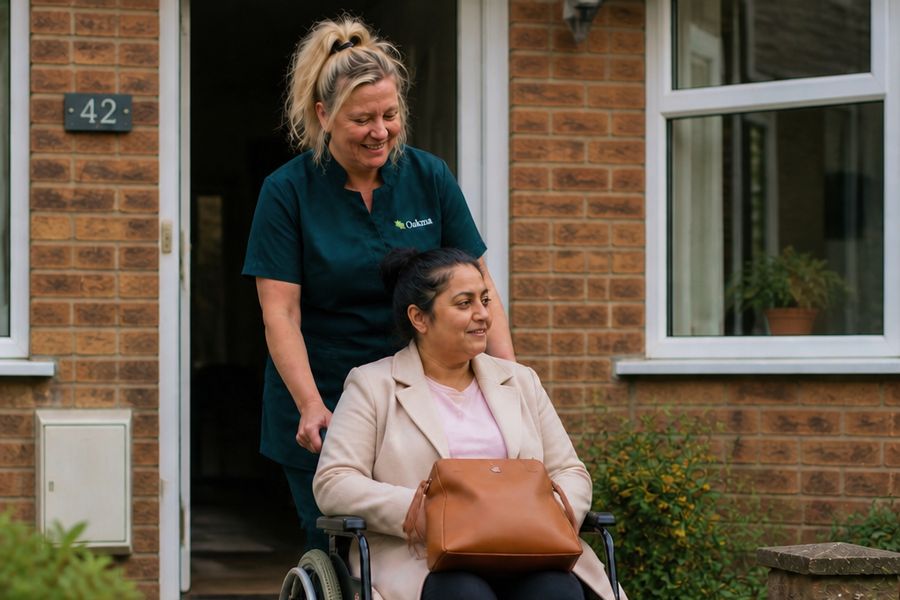
Loneliness rarely announces itself. It creeps in after a bereavement, a driving licence given up, a hip that makes the bus stop feel further away. From the outside, someone can look like they’re coping: the house is tidy, the answers on the phone are “fine, fine”. The weeks, meanwhile, have gone quiet.
This article looks at what loneliness actually does to older people’s health, why it’s a particular issue in and around Telford and Shropshire, and what a regular companionship visit involves. It’s written with Terry Yarnall, who leads care at Oakma after three decades in social care across Shropshire.
At a glance:
- Around 940,000 people over 65 in the UK say they are often lonely; most of them also report being unhappy or depressed.
- The health effect of chronic loneliness is considered on a par with obesity or smoking.
- Rural areas like ours make it worse: distances are longer, transport is thinner, and the older population is growing.
- A companionship visit is a regular, unhurried visit from the same person: conversation, activities, outings, and a watchful eye.
- Families often notice the change within weeks: better eating, better mood, something in the diary again.
The scale of the problem
Age UK’s research report You Are Not Alone in Feeling Lonely found that around 940,000 people aged 65 and over in the UK are often lonely, and that nine in ten of them also describe themselves as unhappy or depressed, compared with four in ten of those who are hardly ever lonely. The NHS adds that more than two million people over 75 in England live alone, and more than a million older people go over a month without speaking to a friend, neighbour or family member. A month. These aren’t edge cases; statistically, several streets in every Telford estate contain someone living this.
What loneliness does to health
Loneliness is a health issue, not just a sad one. A House of Commons Library briefing summarises the evidence: chronic loneliness is linked to early death, with an effect on mortality considered on a par with public health priorities like obesity or smoking, alongside increased risk of depression, sleep problems, cognitive decline and the onset of dementia. The mechanism is unglamorous and practical. People who see no one eat worse, move less, skip appointments, and have no one to notice the early signs when something starts to go wrong.
Why it bites harder around here
The same parliamentary briefing notes that poor transport links and sparse community facilities are obstacles to staying connected, particularly in rural areas where the over-65 population is forecast to keep growing. That describes much of our patch. Telford’s estates were built for car owners, the villages beyond Wellington, Newport and the Wrekin even more so, and when driving stops, the world can shrink to the front room very quickly. Families have often moved away for work, so the weekly visit becomes monthly, then a phone call.
What a companionship visit actually involves
A companionship visit is a scheduled, regular visit from a carer whose job, for that hour or two, is the person rather than a task list. That might mean conversation over tea, a board game or crossword, sorting old photographs, a walk to the shop or the park, a lift to a coffee morning or a place of worship, or watching the snooker with someone who’ll argue about it. Done properly, it also includes a quiet professional eye: a good companion notices the unopened post, the empty fridge, the new unsteadiness on the stairs, and flags it to family early. Consistency is what makes it work; at Oakma, visits come from the same small team of employed carers, because a rotating cast of strangers is company in name only.
A note from Terry: “In thirty years I’ve not seen many interventions work faster than a regular visit from the same person. It’s rarely dramatic. People start eating properly again, they sleep better, they have something in the diary. The visit matters, but so does the looking forward to it.”
Spotting loneliness in a parent
The signs are easy to miss because people hide them, often out of pride. Watch for a parent who has stopped mentioning other people in their week; who phones much more often, or has gone quiet; who has dropped hobbies, church, or the bowls club; whose fridge is emptier than it should be; or whose conversation loops back to the past because the present has little in it. If several of those sound familiar, it’s worth a gentle conversation, and it’s usually better received as “some company during the week” than as “care”.
Frequently asked questions
How often should companionship visits happen?
Most families start with one or two visits a week of an hour or two, then adjust. Regularity matters more than volume: a reliable Tuesday visit that’s looked forward to does more good than occasional longer ones, because anticipation is part of the benefit.
Isn’t family company enough?
Family visits are precious, but they carry obligations and worries on both sides, and they often turn into jobs and logistics. A companionship visit is different: unhurried time with no agenda, plus a professional eye that can reassure family between their own visits rather than replace them.
Will it be the same person each time?
It should be, and you should ask any provider exactly that before starting; consistency is most of the value. Our guide to choosing a home care provider in Telford & Wrekin covers the other questions worth asking.
Is companionship care only for people who live alone?
No. Couples use it too, often so that one partner who is a carer gets a genuine break, and people who live with family use it for company during long weekdays when everyone else is at work or school.
If someone you love has gone quiet and you’re wondering whether a bit of regular company would help, that’s exactly what we do. Oakma provides companionship and help-at-home visits across Telford, Wrekin and parts of Shropshire, from the same small team of well-paid, employed local carers each time. Get in touch or call us on 01952 288 216 and we’ll talk it through, with no pressure.
Terry Yarnall leads care at Oakma, a Telford-based home care company built around employed, well-paid local carers. Terry has spent 30 years in social care: he managed domiciliary care services across Shropshire and Staffordshire with Mencap, developed community care services as CEO of Telford’s Sutton Hill Community Trust, and took part in a CQC sandbox on registering new models of care. He holds a Postgraduate Certificate in Health and Social Service Management.